Newroz, the new day
Newroz, on 21 March, is the most important Kurdish festival. Kurds share the Iranian New Year with Persians and many peoples from the Caucasus to Central Asia, but they tell their own story of it: the blacksmith Kawa rose against the tyrant Zahhak, and lit fires on the mountains to announce freedom. On Newroz, families gather in the countryside, light fires, dance and wear their finest clothes.[1]
Music and the dengbêj
The dengbêj are traditional Kurmanji singer-storytellers who perform long sung narratives of love, war and history, often without instruments. Their songs kept the memory of tribes, battles and leaders, including Simko, alive in a society where writing in Kurdish was often restricted.[1][4]
Kurdish music uses the frame drum def, the long-necked lute tembûr, the reed flute şimşal, and the drum and shawm pair dehol û zurna that leads village celebrations.
Dance and dress
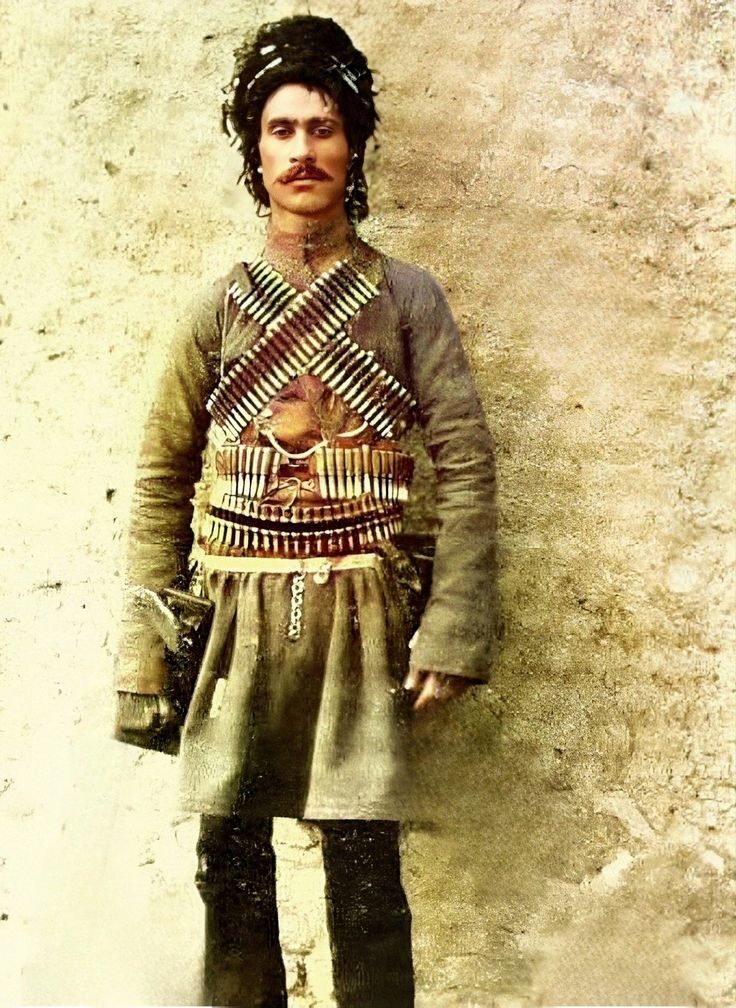
The round and line dances called govend in Kurmanji and helperkê in Sorani join men and women hand in hand, led by a dancer waving a handkerchief. Traditional men's dress includes wide trousers, a sash and a turban or felt cap; the Shikak photographs in our archive show the bandoliers and tall hats of the early twentieth century. Women's dresses are bright and layered, with embroidered vests and coin jewellery.[1]
Poetry and prose
Classical Kurdish poetry flourished from the sixteenth century: Melayê Cizîrî and Feqiyê Teyran in Kurmanji, and later Nalî, Salim and Mahwi in Sorani. Ehmedê Xanî's Mem û Zîn (1692) tells of two lovers kept apart, and has been read as a call for Kurdish unity.[2] The Mukriyan region around Mahabad gave Kurdish literature two of its great twentieth-century poets, Hejar and Hêmin, who served the Republic of Kurdistan in 1946.[4]
Faiths
Most Kurds are Sunni Muslims of the Shafi'i school, and Sufi orders such as the Naqshbandi and Qadiri have shaped Kurdish religious life. Kurds also include Shia Muslims, especially in the south, Alevis, Yezidis and followers of Yarsanism (Ahl-e Haqq), as well as small communities of Kurdish Jews and Christians.[5]
Kurds and Iran: shared roots
Kurdish belongs to the Iranian branch of the Indo-European languages. Linguists class it as a Northwestern Iranian language, while noting many shared features with Persian from long contact.[3] Kurds and Persians share the Nowruz calendar, the heroes of the Shahnameh, and a common heritage reaching back to the pre-Islamic Iranian world. A Kurdish version of the Shahnameh was written in Gorani.[1][3]
For centuries, Kurdish princes such as the Ardalans ruled as part of the Safavid and Qajar states, and Kurdish soldiers served Iranian dynasties. At the same time, the drive for a centralised state in the twentieth century brought conflict, including Simko's revolt and the Republic of Kurdistan. Kurdish identity in Iran has grown in this tension between shared Iranian heritage and a distinct Kurdish language and culture.[1][4]
Urmia: a meeting place of peoples
Simko's homeland around Lake Urmia has long been one of the most diverse regions of Iran. Kurds, Azerbaijani Turks, Assyrians, Armenians and, until the twentieth century, Jews lived side by side in its towns and villages. The tragedies of the First World War struck all of them, and their shared history is part of the story the Institute wants to tell.
Further reading
- Philip G. Kreyenbroek and Stefan Sperl (eds.), The Kurds: A Contemporary Overview, Routledge, 1992.
- Ehmedê Xanî, Mem û Zîn (1692), the classical Kurdish epic in Kurmanji.
- "Kurdish language." Wikipedia, on the classification of Kurdish among the Iranian languages. en.wikipedia.org/wiki/Kurdish_language
- Amir Hassanpour, Nationalism and Language in Kurdistan, 1918–1985, Mellen Research University Press, 1992.
- Martin van Bruinessen, Agha, Shaikh and State, Zed Books, 1992.