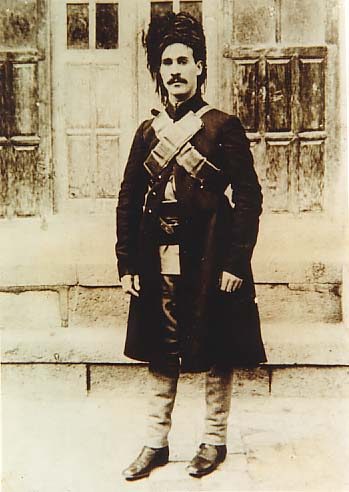
Origins and family
Ismail Agha Shikak was born in 1887 in Chahriq-e Olya, in the Salmas district west of Lake Urmia. His father was Mohammad Agha, and the family led the Awdoyi clan of the Shikak, one of the largest Kurdish tribal confederations of north-western Iran. The family seat was the fortress of Chahriq.[1][6] His great-grandfather, also named Ismail Agha, was the first known chief of the Awdoyi and died in 1816; his tomb stands beside the Naslu river.[2]
The Shikak held the districts of Somay, Baradost, Qotur and Chahriq, in the mountains on both sides of the frontier between the Qajar and Ottoman empires. Until well into the twentieth century this border meant little to the Kurdish tribes, many of whom had pastures on both sides.[3] The name "Simko" is the familiar form of Ismail; Persian historians wrote it as "Simitqu", and Kurds call him Simkoyê Şikak or سمکۆی شکاک.[6]
A young chieftain, 1905–1914
In 1905 his elder brother Jafar Agha, then leader of the tribe, was invited to Tabriz under an oath of safety and killed there on the orders of Qajar officials. Simko, still a young man, became leader of the Shikak.[1] His father later travelled to Istanbul and died in prison there.[1] From 1906 Simko built his power across Qotur, Maku, Khoy and Salmas.[5]
During the Constitutional Revolution he sent horsemen to support the governor of Maku and was rewarded with the post of sub-governor of Qotur.[1][6] In September 1912, when Ottoman soldiers arrested the Kurdish leaders Abdurrezak Bedirkhan and Seyid Taha on their way from Tbilisi, Simko attacked at the frontier and freed them.[5]
In 1913, with Abdurrezak Bedirkhan and Russian support, he helped open a Kurdish school where teachers from the Caucasus taught about 30 children in Kurdish and Russian. Kurdish sources place it in Khoy, others in Maku.[5][1] When the two men disagreed in 1914, Simko argued that the school would help the Kurds more than fighting a few Ottoman soldiers.[1]
The First World War, 1914–1918
The war turned the Urmia region into a battlefield between the Ottoman and Russian armies. When Ottoman forces took Urmia and Tabriz in December 1914, Simko sided with them. In late 1914 he was shot at near Jolfa and then exiled by the Russians to Tbilisi; they released him in 1916 and allowed him to return to Qotur.[1][5]
These years brought great suffering to every community of the region. Assyrians driven from Hakkari arrived in Urmia and Salmas under their patriarch Mar Shimun XIX Benyamin, and after the Russian army withdrew in 1917 Kurdish and Assyrian forces competed for control.[6] Historians record that Simko's men took part, with Ottoman forces, in the killing of Armenian and Assyrian villagers at Haftevan in February 1915.[1]
In March 1918 Simko received Mar Shimun at Kohnashahr near Salmas for talks about an alliance. The patriarch and many of his escort were killed. Simko later said that Mar Shimun planned an Assyrian state in Kurdistan with Russian backing.[5][6] The killing set off a cycle of reprisals against Kurdish and Muslim villages, and then against Assyrians and Armenians; the Jewish community of Kohnashahr also suffered severely.[6][4]
A difficult chapter
The Institute does not hide the violence of this period. Christians, Muslims, Jews, Kurds, Assyrians, Armenians and Azerbaijanis all lost lives in the war and the years that followed. Our aim is an honest history that every community of the region can read.
The revolt, 1918–1922
With the Qajar state weakened by war and famine, Simko built a coalition of Kurdish tribes and began a revolt that is often described as the first major attempt to create a Kurdish state in Iran.[11] In a letter from about 1919 he wrote that many of the world's smaller nations had their own states.[5]
In 1919 a bomb disguised as a gift, sent by the governor of Tabriz, Mokarram al-Molk, exploded at Chahriq. Simko survived, but his brother Ali Agha and others were killed.[1][5] The same year he joined a gathering of Kurdish leaders discussing an independent Kurdish entity, and with Seyid Taha he asked the British for support, without a firm answer.[6]
On 17 July 1920 his commander Amar Khan Shikak took the port of Golmakhana and strategic points around Urmia.[5] Simko appointed governors, including Teymur Agha Shikak in Urmia, and extended his authority over the Urmia and Salmas plains and parts of Khoy.[6] In October 1921 his forces took Mahabad (then Sauj Bulagh), killing or capturing hundreds of government soldiers, and made it a centre of his rule.[1][5]
Later in 1921 a large government force under Amir Arshad, with the Swedish-led gendarmerie, marched against him. Amar Khan's men defeated it and Amir Arshad was killed. Kurdish sources date this battle, at Shakariaz, to December 1921; other accounts place a battle with Amir Arshad near Tasuj in October.[5][1] At its height his influence reached Baneh, Sardasht and Saqqez.[6]
In July 1922 Simko published the newspaper Kurd in Urmia, in Kurdish and Persian, and signed himself "Partisan of the Independence of Kurdistan".[5][1]
Where the revolt took place
The map shows the region west and south of Lake Urmia, with the approximate area under Simko's authority at its height in 1921–22 and the key places of his life.
How Simko governed
Simko's rule was not yet a state with fixed institutions. It rested on his personal authority, alliances with tribes such as the Herki, Mamash, Mangur and Dehbokri, and an army whose size rose and fell with success in battle.[6]
Yet it had features of a Kurdish government. Kurdish was used in parts of the administration, the newspaper Kurd appeared in Kurdish and Persian, and some studies credit him with supporting Kurdish-language schools.[6][7] His followers called the revenue he raised taxation; many residents and Iranian sources called it plunder, and raids also struck Kurdish towns.[6]
Defeat and exile, 1922–1926
The new commander in Tehran, Reza Khan, rebuilt the army and turned it against the tribal leaders of Iran. In the summer of 1922 a large force, given as 10,000 to 15,000 soldiers under General Jahanbani, attacked his stronghold at Chahriq. Kurdish sources date the assault to 27 July 1922. Simko withdrew towards the Turkish border, many allies deserted him, and Mahabad was retaken in August.[1][5][6]
In October 1922 Turkish forces attacked Shamane: his wife Jawahir was killed and his six-year-old son Khusrow was captured. On 6 November 1922 he met British officials under C. J. Edmonds near Erbil, who promised nothing.[5] On 8 January 1923 Sheikh Mahmud Barzanji received him in Sulaymaniyah with a parade and a gun salute, but the two leaders reached no agreement, and Simko left on 23 March.[5][1]
After the Treaty of Lausanne in July 1923 he could no longer stay in Turkey and settled on Mount Dalampar, where Iran, Iraq and Turkey meet.[5] In 1924 Reza Khan pardoned him, and he returned to Howasne in the Somay district of Urmia.[5][8]
Final years and death, 1926–1930
In 1926 Simko regained leadership of the Shikak and, allied with the Herki and Begzadeh tribes, attacked Salmas with about 1,500 men. Divisions among his allies defeated the attempt; government forces from Urmia, Sharafkhaneh and Khoy pursued him, and he crossed into Iraq.[5][8] In 1928 he made a new agreement with the Turks and settled in Gawar, in northern Kurdistan.[5]
In 1930, through Teymur Agha Shikak, Colonel Sadeq Khan Nowrozi invited him to Oshnavieh (Shino) to meet General Hassan Moqaddam, with the offer of an official post. Simko accepted, and he was killed in a planned ambush, the same fate his brother had met twenty-five years earlier.[5][6]
How historians see Simko
Simko remains one of the most debated figures of modern Kurdish history. Scholars broadly hold three views, and the Institute presents all of them.
A national leader
Many Kurdish writers call him a founder of the Kurdish national movement in Iran. Kamal Soleimani argues that he was a Kurdish nationalist who made Kurdish the language of his territory and promoted schools and a newspaper.[7]
Legacy
Reza Shah believed Simko's death had ended Kurdish resistance in Iran. Eleven years later his own government fell, and in 1946 veterans of Simko's movement, among them Amar Khan Shikak, took part in the Republic of Kurdistan in Mahabad under Qazi Muhammad.[5][1]
Today Simko's name lives on in Kurdish songs, books and memory across Iran, Iraq, Turkey, Syria and the diaspora, and he remains a subject of new research, including at the Kurdish Studies Conference at the London School of Economics in 2025.
The Simko Shikak Institute was founded so that this history can be studied from the original sources: family photographs, letters and testimonies, alongside the work of historians.[12]
Simko Shikak, 1887–1930
- Born in Chahriq-e Olya, Salmas, into the leading family of the Shikak.
- His brother Jafar Agha is killed in Tabriz. Simko becomes leader of the Shikak.
- Builds his power across Qotur, Maku, Khoy and Salmas.
- Frees Abdurrezak Bedirkhan and Seyid Taha from Ottoman soldiers.
- Helps open a Kurdish school with Abdurrezak Bedirkhan.
- Sides with the Ottomans; exiled by the Russians to Tbilisi; released in 1916.
- Mar Shimun XIX Benyamin is killed at Kohnashahr after talks with Simko.
- The Simko Shikak revolt begins.
- Survives a bomb attack; his brother Ali Agha is killed. Asks the British to support Kurdish independence.
- Amar Khan Shikak takes Golmakhana and key points around Urmia.
- Captures Mahabad and makes it a centre of his rule.
- Defeats the government army of Amir Arshad.
- Publishes the newspaper Kurd in Urmia. Chahriq is attacked; Simko withdraws.
- His wife Jawahir is killed and his son Khusrow captured at Shamane.
- Received by Sheikh Mahmud Barzanji in Sulaymaniyah.
- Pardoned by Reza Khan; returns to Howasne in Somay.
- Second revolt; attacks Salmas with about 1,500 men; withdraws to Iraq.
- Settles in Gawar under an agreement with Turkey.
- Killed in an ambush in Oshnavieh (Shino).
- Veterans of his movement take part in the Republic of Kurdistan in Mahabad.
Sources for this page
- "Simko Shikak." Wikipedia, drawing on the scholarship listed on our research page. en.wikipedia.org/wiki/Simko_Shikak
- "Shekak (tribe)." Wikipedia, after Houtsma (ed.), E.J. Brill's First Encyclopaedia of Islam, 1913–1936. en.wikipedia.org/wiki/Shekak_(tribe)
- Martin van Bruinessen, "A Kurdish Warlord on the Turkish-Persian Frontier in the Early Twentieth Century: Isma'il Agha Simko," in T. Atabaki (ed.), Iran and the First World War, I.B. Tauris, 2006, pp. 69–93. Academia.edu
- David Gaunt, Massacres, Resistance, Protectors: Muslim-Christian Relations in Eastern Anatolia during World War I, Gorgias Press, 2006.
- "Simko Shikak; a revolutionary figure" (series), KurdShop, after Mohammad Saleh Qaderi, Amarkhan Shikak: from the Rise of Simko to the Kurdistan Republic, 2021. kurdshop.net/en/history/2627
- "Simko Shikak (Ismail Agha Shikak)." The Diary of Sinior Demirel, with historical notes. demirel.co.il
- Kamal Soleimani, "The Kurdish image in statist historiography: the case of Simko," Middle Eastern Studies 53(6), 2017.
- "Simko Shikak revolt (1926)." Wikipedia, after van Bruinessen 2006. en.wikipedia.org
- Richard Tapper (ed.), The Conflict of Tribe and State in Iran and Afghanistan, Croom Helm, 1983 (Routledge, 2012).
- Mehrdad Kia, The Clash of Empires and the Rise of Kurdish Proto-Nationalism, 1905–1926, Springer, 2023.
- Benjamin Smith, "Land and Rebellion: Kurdish Separatism in Comparative Perspective," working paper, 2009.
- Dr. Keivan Simko, "Ismail Agha Simko (Simko Shikak)" [Persian], Academia.edu. academia.edu/107339961