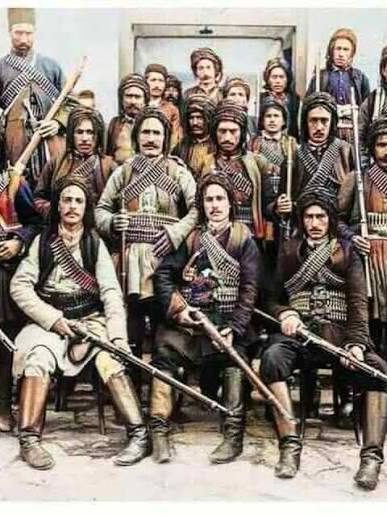
Land and people
Kurdistan, "the land of the Kurds", is a mountainous region where the Zagros and Taurus ranges meet, around the upper Tigris and Euphrates and the great lakes of Van and Urmia. Today it is divided between Turkey, Iran, Iraq and Syria, and Kurds call these parts Bakur (north), Rojhelat (east), Başûr (south) and Rojava (west).[2]
The mountains have protected Kurdish communities and their languages for centuries, and they explain much of Kurdish history: pastoral tribes moving between summer and winter pastures, strong local leaders, and empires that ruled the plains but rarely the highlands.[1]
Ancient roots
The origins of the Kurds are debated. The Greek historian Xenophon describes the Kardouchoi, a mountain people who fought his army in 401 BC, and many scholars connect the Kurds with the Iranian peoples who settled the Zagros in the first millennium BC, among them the Medes. Modern historians treat these links with caution: Kurdish identity formed over many centuries from many peoples of the region.[2]
The Islamic centuries
From the seventh century most Kurds became Muslims, largely of the Shafi'i school of Sunni Islam, while others kept older faiths such as Yezidism and Yarsanism (Ahl-e Haqq). Kurdish dynasties ruled parts of the region in the tenth to twelfth centuries, including the Shaddadids in the Caucasus and the Marwanids in Diyarbakir. The most famous Kurd of the Middle Ages, Salah al-Din (Saladin), founded the Ayyubid dynasty in the twelfth century.[2]
Between empires: the Kurdish emirates
After the Battle of Chaldiran in 1514, Kurdistan became the frontier between the Ottoman and Safavid empires, a line confirmed by the Treaty of Zuhab in 1639. Both empires governed through Kurdish princes, and semi-independent emirates flourished: Ardalan, Baban, Soran, Bohtan, Bitlis, Hakkari and the Mukri of Mukriyan.[2][7]
This was the age of the first Kurdish history, the Sharafnama of Sharaf Khan Bidlisi (1597), and of the national epic Mem û Zîn by Ehmedê Xanî (1692).[4] In the nineteenth century, the Ottoman and Qajar states abolished the emirates one by one, and tribal chiefs and religious sheikhs took their place as the leaders of Kurdish society.[1][3]
Tribe, agha and sheikh
Martin van Bruinessen's classic study describes the three pillars of traditional Kurdish society: the tribe (eşîret), its chief, the agha, and the Sufi sheikh, whose religious authority could unite many tribes.[1] Tribes ranged from small kin groups to large confederations such as the Shikak, Herki and Mangur, and many combined farming with seasonal pastoralism.
Simko's own life shows this world: a tribal confederation on an imperial frontier, alliances sealed by marriage and loyalty, and relations with the sheikhs of Nehri, whose descendant Seyid Taha was his ally and relative by marriage.[1][3]
Treaties, states and movements
The revolt of Sheikh Ubeydullah of Nehri in 1880 was among the first to speak of a Kurdish nation.[3] After the First World War the Treaty of Sèvres (1920) foresaw possible Kurdish autonomy, but the Treaty of Lausanne (1923) divided Kurdistan between Turkey, Iran, Iraq and Syria. The 1920s and 1930s brought revolts across Kurdistan, among them Simko in Iran, Sheikh Mahmud Barzanji in Iraq and Sheikh Said in Turkey.[2][3]
In 1946 the short-lived Republic of Kurdistan in Mahabad, under Qazi Muhammad, became a lasting symbol for Kurds everywhere. Later decades saw long conflicts, mass displacement, and in Iraq the Anfal campaign of the 1980s. Since the 1990s the Kurdistan Region of Iraq has governed itself, recognised in Iraq's 2005 constitution.[2]
The Kurds of Iran
In Iran, Kurds live in West Azerbaijan, Kurdistan, Kermanshah and Ilam provinces and parts of Hamadan and Lorestan, with an old Kurmanji-speaking community in Khorasan.[6] The weakness of the Persian state during the First World War allowed Simko to establish his authority west of Lake Urmia from 1918 to 1922; the Republic of Kurdistan followed in 1946.[6][5]
The Kurds today
Kurds today are teachers and farmers, scholars and artists, in the cities of the Middle East and across Europe, especially Germany, Sweden and the United Kingdom. Kurdish studies is an active field, with centres such as the Zakho Center for Kurdish Studies, whose conferences explore the social history of Kurdish tribes in the Ottoman–Iranian era.[7]
Further reading
- Martin van Bruinessen, Agha, Shaikh and State: The Social and Political Structures of Kurdistan, Zed Books, 1992.
- David McDowall, A Modern History of the Kurds, I.B. Tauris, 3rd ed., 2004.
- Wadie Jwaideh, The Kurdish National Movement: Its Origins and Development, Syracuse University Press, 2006.
- Sharaf Khan Bidlisi, Sharafnama (1597), the first history of the Kurds, written in Persian.
- Farideh Koohi-Kamali, The Political Development of the Kurds in Iran, Palgrave Macmillan, 2003.
- "Iranian Kurdistan." Wikipedia. en.wikipedia.org/wiki/Iranian_Kurdistan
- Zakho Center for Kurdish Studies, University of Zakho: conference programme on the social history of Kurdish tribes in the Ottoman–Iranian era (1514–1914). zcks.uoz.edu.krd